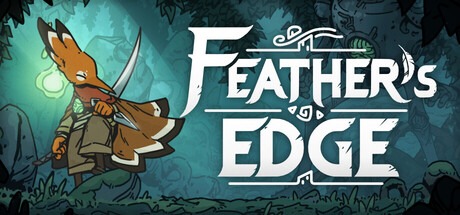
Feather’s Edge Wants to Turn the Metroidvania Into a Blade-Sharp Test of Motion, Timing and Mastery
Feather’s Edge is not out yet, so this is not a review. There is no score here, no final verdict and no claim that the full game already delivers on everything it is promising. What we have instead is exactly what our Indie Showcase page is meant for: an upcoming game with a clear identity, a memorable visual hook and a design idea strong enough to make us pay attention before release.
Developed by Clockwork Acorn and published by Clockwork Acorn together with Outersloth, Feather’s Edge is currently listed on Steam with a release date still to be announced. The game is described as a kinetic metroidvania, which is a phrase that immediately tells you where its ambition lies. This is not just another side-scrolling action adventure where players unlock new routes, fight enemies and gradually map out a mysterious world. Feather’s Edge appears to be built around the idea that movement itself should feel like combat, and combat should feel like movement.
That distinction matters.
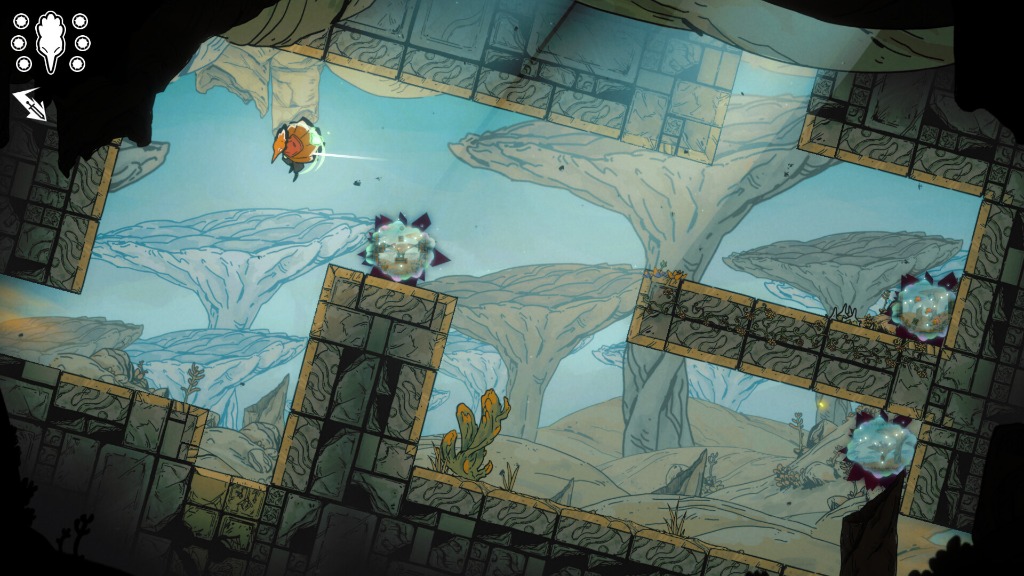
Many metroidvanias separate traversal and fighting into two overlapping systems. You jump, climb, dash, wall-slide and explore; then, when an enemy blocks the way, you switch into attack mode. Feather’s Edge seems to want those moments to become one continuous action. Its “dash and slash” setup presents every encounter as a compact test of timing, positioning and decision-making. The Steam description talks about bite-sized battles, precision, quick thinking and tactical mastery, which makes the game sound less like a slow exploration-heavy adventure and more like a challenge-driven action platformer where each movement is a commitment.
The player controls Upu, a Hoopoe bird warrior climbing the Tower of Time before it collapses completely and takes the world with it. That is already a strong foundation for an indie fantasy world. A bird warrior gives the game a silhouette and personality that immediately separates it from the many hooded knights, masked wanderers and silent swordfighters that fill the genre. The Tower of Time also gives Clockwork Acorn a flexible structure for variety. The game’s world is described as fractured by the collapse of time, with regions shaped by irregular flows of history, including ancient jungles, lava flows, freezing winds and rifts in the fabric of time.
For players, that could mean one of the most important things a metroidvania needs: environmental variety with a reason to exist. The best games in this genre do not just give players a map; they give them a place worth learning. A tower broken by time has room for strange geography, sudden visual contrast and mechanical changes between regions. If Clockwork Acorn can make each area feel different not only in art direction but also in movement rhythm, enemy design and challenge structure, Feather’s Edge could become the kind of indie game that rewards both curiosity and skill.
The most interesting feature so far is the time-rift system. These are presented as short combat challenges that can be completed in seconds, revisited, improved and mastered. That detail suggests Feather’s Edge may be aiming for a satisfying loop beyond simple progression. It is not only about getting through an area once. It is about returning, understanding the encounter better, refining your route and improving your execution. That gives the game a score-attack flavour, even inside a metroidvania structure.
This is where Feather’s Edge could really find its audience.
There is a large group of players who enjoy metroidvanias for exploration, secrets and atmosphere. There is another group that loves precision platformers and action games because they turn failure into practice and practice into mastery. Feather’s Edge seems to be trying to stand between those two groups. It wants the mystery and world-building of a non-linear adventure, but it also wants the sharp, repeatable satisfaction of clearing a difficult encounter with elegance. That combination can be powerful if the controls feel good.
And honestly, control feel is everything here. A game built around kinetic movement cannot afford to be almost right. The dash must be readable. The slash must feel fair. Enemy placement needs to be demanding without becoming messy. Level design has to teach players through motion rather than constant instruction. If Feather’s Edge gets that feel right, the entire game could sing. If it misses, even beautiful art and good world-building will not save it, because the central promise is physical: move well, strike cleanly, master the bird warrior.
The studio behind it gives us a reason to be optimistic. Clockwork Acorn is a South African indie studio that describes its focus as creating timeless games with “chunky design.” That phrase sounds playful, but it also suggests a design philosophy built around clarity, weight and memorable interactions. The studio has previous work including Jetstream, Upupa Bird Ninja and Enter the Titan, and has also been associated with Terra Nil: Vita Nova. Feather’s Edge looks like a natural evolution of those interests: compact systems, readable action and a world with a distinctive identity.
The involvement of Outersloth is also worth noting. Outersloth has become an interesting name in the indie space because it is connected to the team behind Among Us and exists to help fund independent projects. For a game like Feather’s Edge, that kind of backing can matter. It does not automatically guarantee quality, but it may give the developer more room to polish, iterate and reach players who would otherwise miss it in the crowded Steam release schedule.
Visually, Feather’s Edge is using a hand-drawn, stylized 2D look that fits the premise well. The screenshots and presentation suggest a game that wants to feel sharp but not sterile, challenging but not grim. The bird-warrior fantasy gives it personality, while the fractured Tower of Time gives it enough dramatic weight to avoid feeling like a simple arcade challenge collection. That balance could be important. A pure precision game needs clean readability; a metroidvania needs atmosphere. Feather’s Edge has to deliver both.
What do we hope it becomes?
We hope Feather’s Edge becomes the kind of indie action game where every mistake feels like the player’s fault, but every retry feels exciting rather than exhausting. We hope the Tower of Time is more than a backdrop and becomes a place full of secrets, shortcuts and surprises. We hope Upu’s abilities grow in ways that change how players read the map, not just how many locked doors they can open. Most of all, we hope the time-rift challenges become little pockets of design excellence: short, sharp, replayable encounters that make players say, “One more try,” long after they planned to stop.
There is also potential here for speedrunners and challenge players. A metroidvania with bite-sized combat rooms, tactical mastery and movement-based combat naturally invites optimization. If Feather’s Edge includes strong timing windows, expressive routing and meaningful replay value, it could build a community around mastery rather than just completion. That would be a smart direction for an indie game trying to stand out.
For now, Feather’s Edge belongs on the wishlist of players who enjoy metroidvanias, precision platformers, swordplay-focused action games and stylish indie worlds with a strong central mechanic. It is too early to judge how deep the final game will be, how large the world is, how satisfying progression feels or whether the difficulty curve stays fair. But as a coming-soon showcase, this is exactly the kind of project we like to highlight: a game with a clear idea, a studio with personality and enough design confidence to make a familiar genre feel fresh again.
Feather’s Edge is currently listed as coming to Steam, with the release date still to be announced. Players can wishlist the game and request access to the playtest through its Steam page.