Grim Trials Review – Death, Heavy Metal and the Afterlife's Most Dangerous Internship
 GFA METERSTRONG
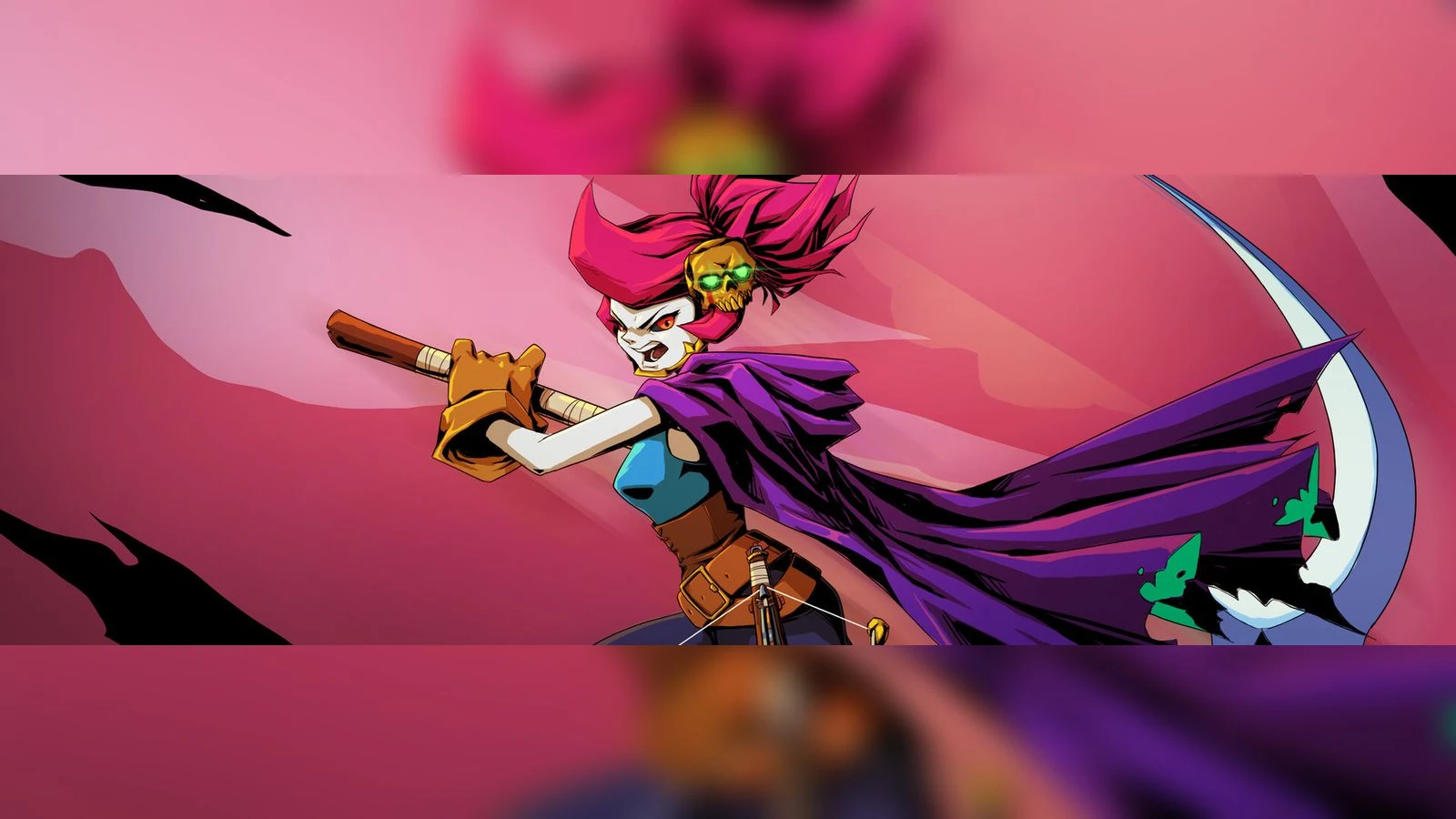
Dying is usually considered a rather serious career setback. In Grim Trials, it's merely the entrance examination. Indonesian developer Glory Jam invites us into an afterlife filled with deadly monsters, divine powers, questionable occupational safety standards and enough heavy metal to make Satan complain about the noise.
GameForce Asia | November 6, 2026
Reviewed by GFA Staff
Developer: Glory Jam (Indonesia)
Publisher: Soft Source (Singapore)
Genre: Action Roguelite / Hack and Slash / Action RPG
Platforms: PC (Steam), PlayStation 5, Xbox Series X|S, Nintendo Switch and Nintendo Switch 2
Release Date: August 2026
Review Basis: Research-based editorial assessment informed by official game materials, developer updates, independent reviews and player feedback.
GFA METER: 83% – STRONG
Welcome to the Afterlife. Your Orientation Starts With a Scythe.
Death has always been one of life's great inconveniences. One moment you're going about your business, perhaps enjoying a coffee or worrying about your electricity bill, and the next you're standing before the pearly gates wondering whether anybody remembered to cancel your Netflix subscription.
For Avelin, the unfortunate heroine of Grim Trials, dying is considerably more complicated. Rather than being allowed to enjoy eternal rest, she finds herself recruited into an academy dedicated to training aspiring Grim Reapers.
Apparently, even the afterlife has a human resources department.
Developed by Indonesian studio Glory Jam, previously responsible for titles including Rage in Peace, What Comes After and Hello Goodboy, Grim Trials takes the familiar action-roguelite formula and gives it a distinctly heavy-metal makeover. There's hack-and-slash combat, divine blessings, deadly bosses, extensive weapon crafting and a surprisingly personal story about love, loss and the rather unreasonable lengths one might go to for a second chance.
The inevitable comparison is Hades, Supergiant Games' enormously successful action roguelite. Both games feature repeated attempts through hostile environments, supernatural abilities, character relationships and an underworld that seems remarkably unwilling to let anyone enjoy a quiet afternoon.
But while Grim Trials wears those influences quite openly, it brings enough personality of its own to justify attention, particularly through its equipment crafting and the emotional motivation behind Avelin's journey.
Seven Deadly Bosses and a Very Unhealthy Work Environment
The central gameplay revolves around entering the Trial Grounds, battling monsters, gathering resources and, inevitably, dying. A lot.
Fortunately, death isn't the end of the road. Each unsuccessful expedition contributes experience and materials towards strengthening Avelin for subsequent attempts.
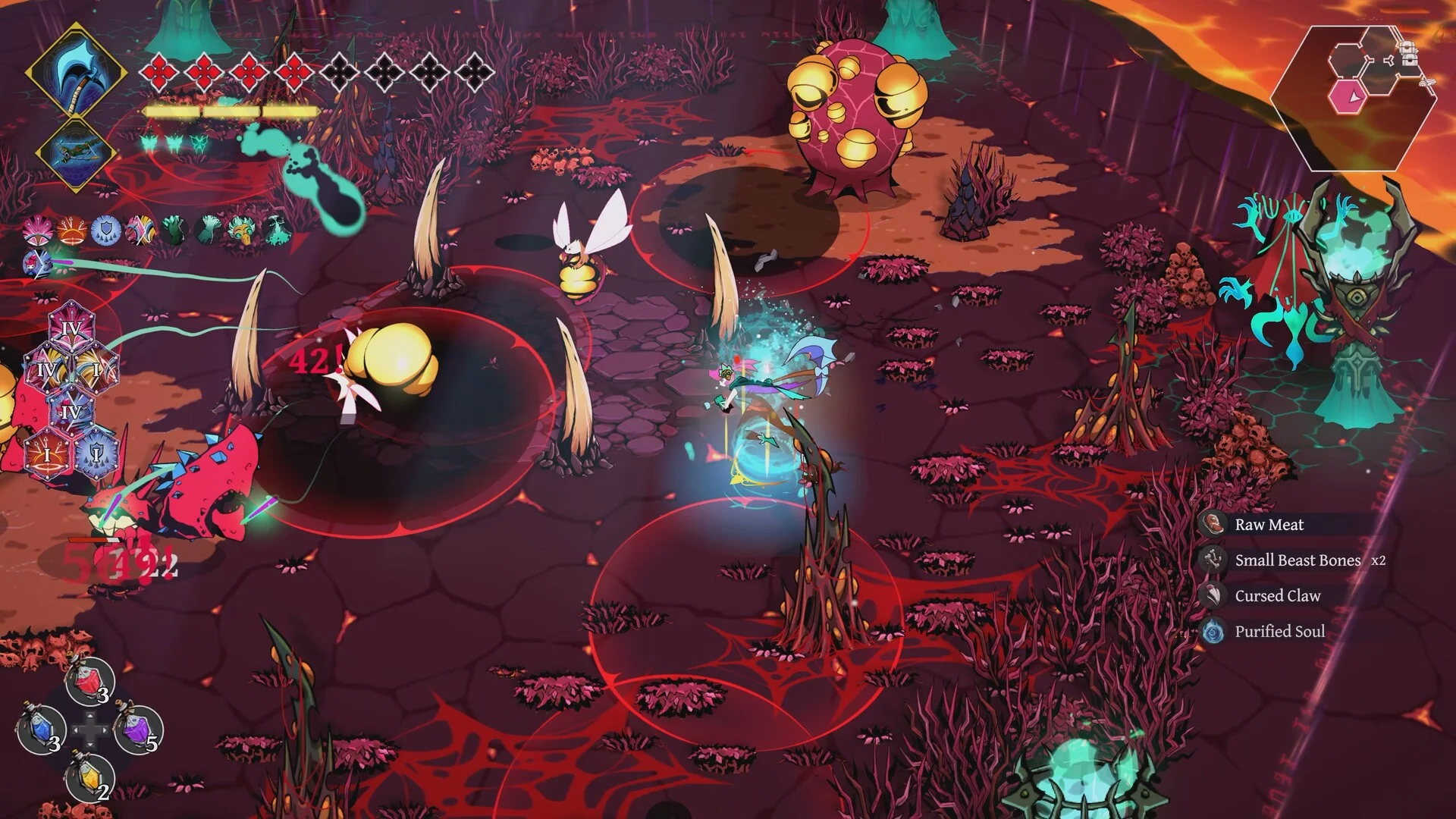
Combat combines melee weapons, including scythes and axes, with ranged crossbows. The idea is to alternate and combine attacks rather than relying on a single weapon to solve every disagreement.
And there are plenty of disagreements.
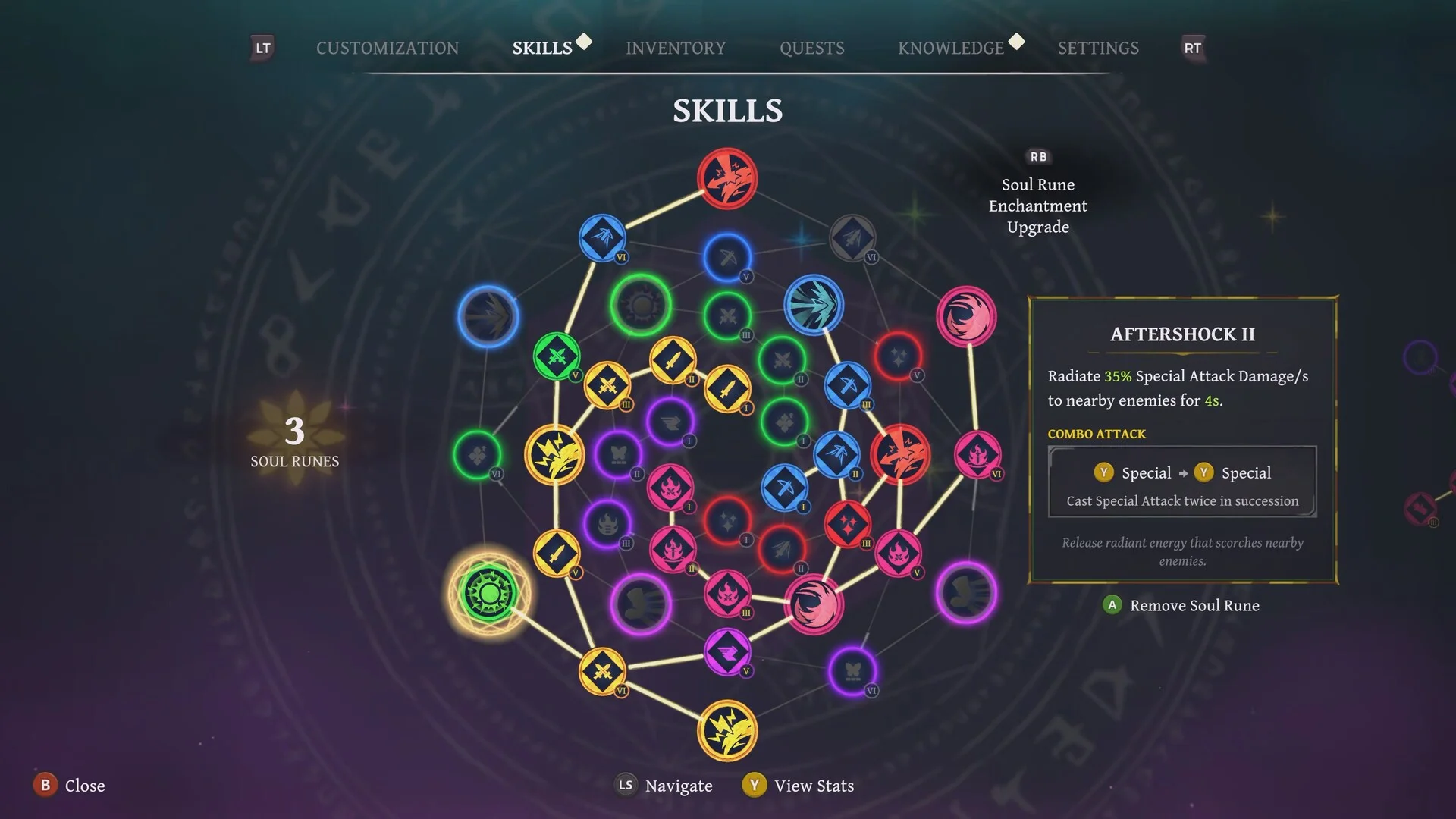
The game's interconnected hexagonal arenas contain ordinary enemies, environmental hazards, traps and seven major bosses inspired by the deadly sins. Different encounters demand awareness of enemy positioning, attack patterns and the appropriate moment to unleash a particularly unpleasant combination of steel and supernatural violence.
The dual-weapon structure provides a welcome tactical foundation. Melee attacks deliver the immediate satisfaction expected from a hack-and-slash game, while crossbows offer opportunities to interrupt enemies and control dangerous encounters from a safer distance.
It's a system with considerable potential, particularly when combined with blessings that modify offensive capabilities.
There is, however, a limitation. Independent reviews and player feedback suggest the weapons don't always feel sufficiently distinct, while the selection of blessings can become familiar sooner than dedicated roguelite enthusiasts might prefer.
That matters in a genre where discovering unexpected combinations is half the fun. The finest roguelites make players feel like deranged scientists experimenting with powers that absolutely should not be combined. Grim Trials offers that experience in a more compact form, but the number of truly transformative discoveries appears comparatively limited.
The underlying combat remains appealing, especially for players looking for an accessible entry into the genre rather than a game demanding hundreds of hours of experimentation.
Crafting Your Own Instruments of Destruction
One of Grim Trials' more interesting ideas is its approach to equipment progression.
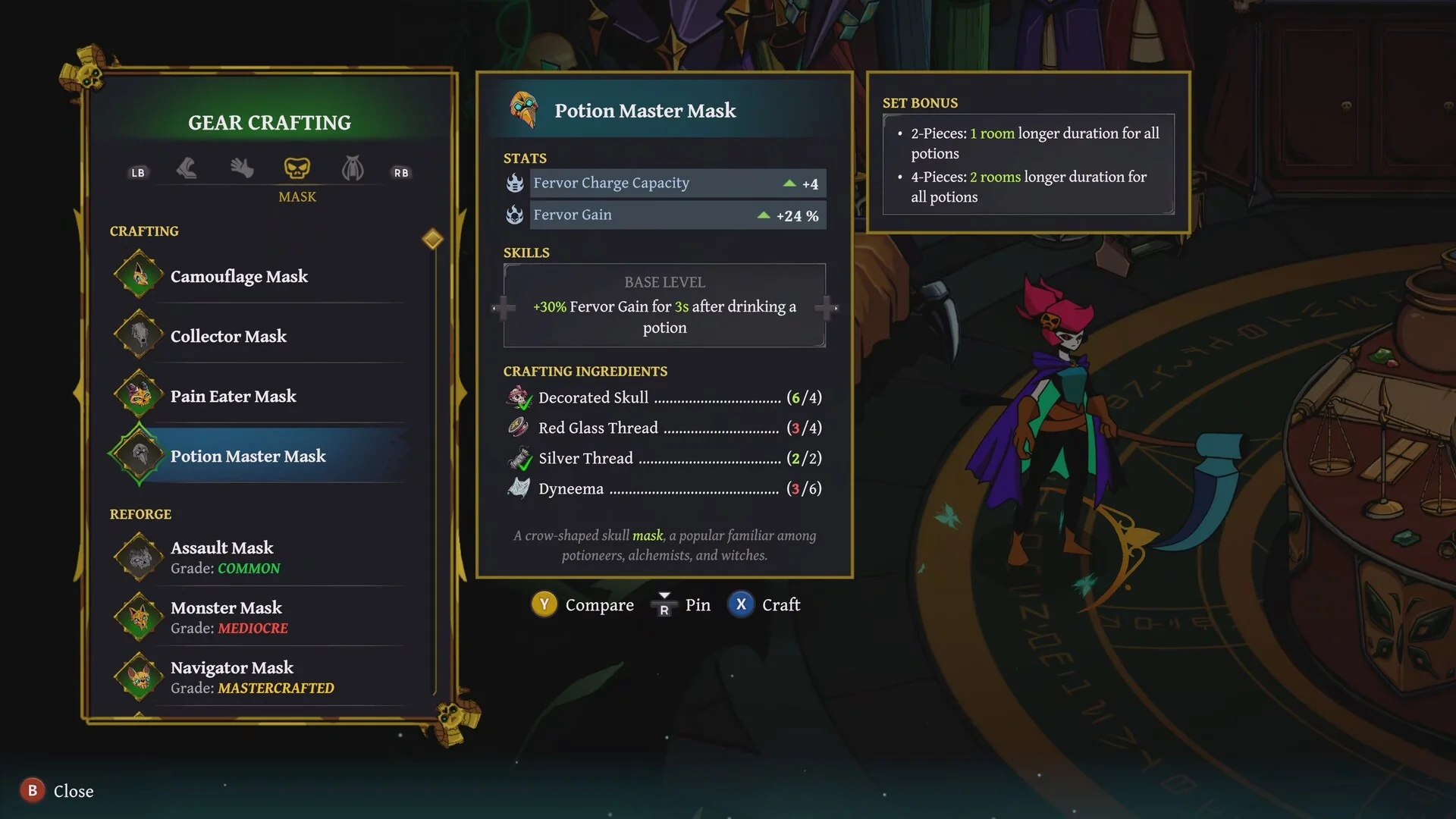
Instead of simply selecting upgrades from a menu and watching statistics increase, players gather materials throughout their expeditions and return to the Academy to craft weapons, armour and consumables.
Crafting incorporates a timing-based minigame, adding a more interactive dimension to equipment creation. It is a small but interesting departure from traditional crafting systems, where producing a legendary weapon frequently involves nothing more challenging than clicking a button and pretending you've mastered blacksmithing.
Here, successful timing influences the quality of your creations.
The system helps make the equipment feel earned, although it also introduces frustration when attempts fail. Some players have criticised its unforgiving nature, particularly when valuable materials are at stake. Others have appreciated the extra interaction.
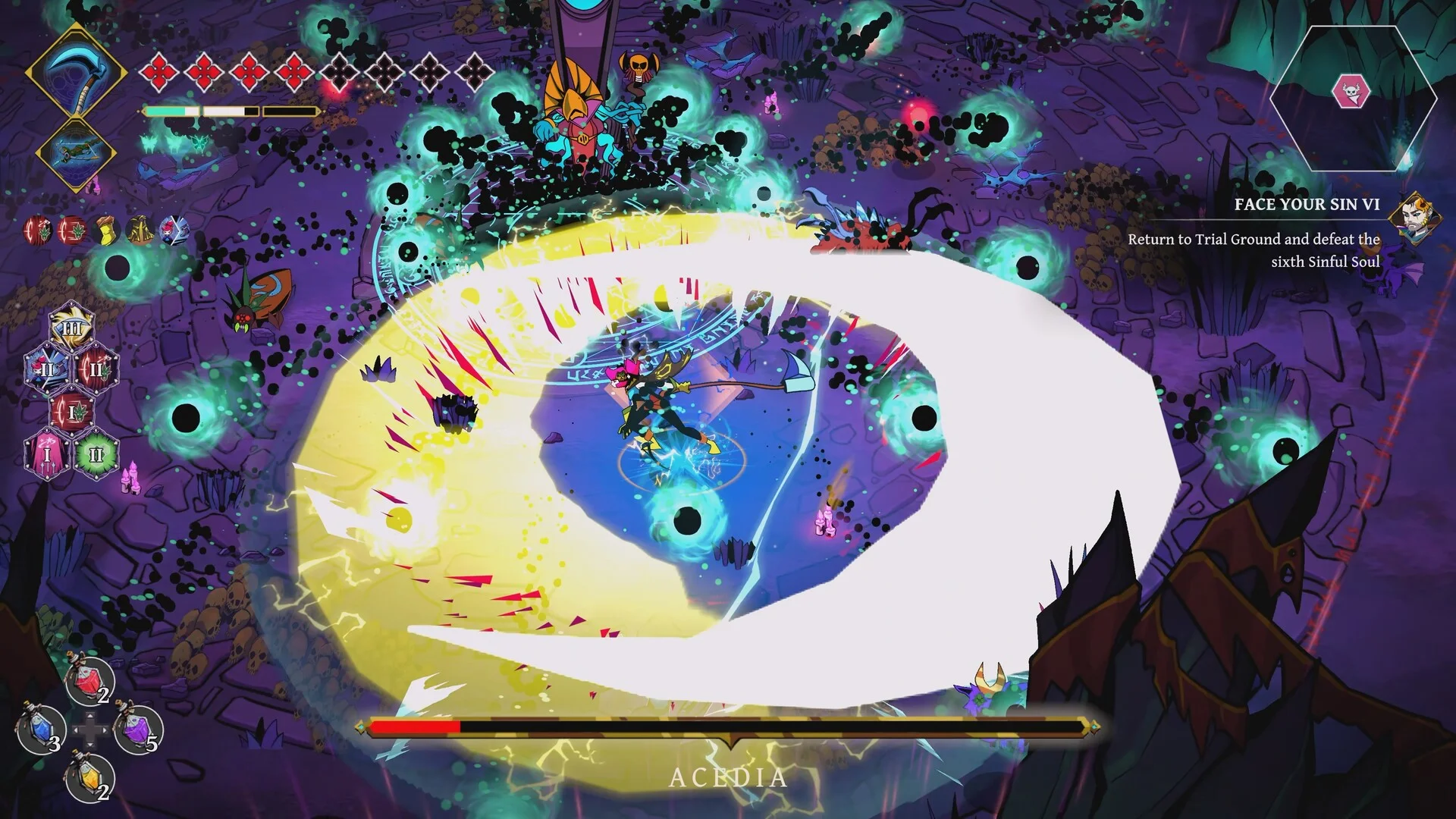
Beyond crafting, an expansive skill tree and randomly awarded divine blessings allow Avelin to develop different combat builds. Choosing appropriate equipment before a run and adapting to whatever powers become available provides an enjoyable layer of planning.
The larger question is whether those choices create sufficient variety over repeated attempts.
For casual players, the available combinations should offer meaningful progression and experimentation. More demanding genre veterans may find themselves settling into a preferred build relatively quickly.
Sometimes discovering the perfect weapon is satisfying. Other times it simply means you've accidentally made everything else in the armoury redundant.
An Academy Where Nobody Gets to Graduate Alive
Grim Trials understands that endless combat becomes considerably more interesting when there's a reason to keep fighting beyond watching numbers increase.
Avelin isn't simply trying to become the greatest Grim Reaper because the job comes with excellent benefits and a competitive pension scheme.
Her motivation is deeply personal.
Having died unexpectedly, she hopes to reunite with the person she loves, who remains among the living. That emotional objective gives her supernatural apprenticeship an unusual sense of purpose.
Between expeditions, players explore the Academy, meet other Reapers, interact with mentors and gradually discover the stories of the people inhabiting this peculiar corner of the afterlife.
Relationships, quests and conversations complement the combat systems, creating opportunities to learn about the characters while unlocking useful support and equipment.
It's a sensible approach, particularly considering Glory Jam's previous experience with narrative-driven games.
Rather than treating the story as something that occasionally interrupts the fighting, Grim Trials uses the Academy to connect its repeated deaths into a larger personal journey.
The narrative may not offer the extraordinary depth and sheer quantity of dialogue found in Hades, but its more focused structure can also be an advantage.
Not every game needs several dozen hours of philosophical discussions with immortal beings before it reaches the point.
Sometimes a straightforward, emotionally grounded story is enough.
A Heavy-Metal Afterlife With Surprisingly Good Taste
Visually, Grim Trials makes an immediate impression through its colourful, hand-drawn aesthetic.
The environments combine dark-fantasy imagery with bold colours, supernatural architecture and energetic combat effects. Character illustrations and stylised enemies contribute to an atmosphere that feels more adventurous than oppressive.
It would have been easy to create an underworld consisting entirely of black corridors, grey skeletons and various shades of miserable brown.
Thankfully, Glory Jam has rather more imagination.
The visual presentation gives the game a recognisable personality, while the distinct enemy designs and colourful environments help establish a world that feels considerably less generic than its familiar genre structure might suggest.
And then there's the music.
Grim Trials leans enthusiastically into its heavy-metal identity, using energetic guitar-driven tracks to accompany combat and dramatic confrontations.
It's an appropriate choice. Nothing quite communicates the seriousness of fighting supernatural monstrosities like a particularly aggressive guitar riff.
The soundtrack's relatively modest selection of tracks limits its long-term variety, but its musical direction complements the game's visual identity and aggressive combat philosophy.
Together, the art and music form one of Grim Trials' strongest selling points.
The Trouble With Following in Hades' Footsteps
No discussion of Grim Trials would be complete without addressing the enormous, scythe-shaped elephant in the room.
Hades.
Comparisons are inevitable, and not always flattering.
Grim Trials adopts many familiar conventions: repeated dungeon runs, divine enhancements, a character-filled central hub, weapon upgrades and narrative progression tied to death.
None of these ideas belongs exclusively to Supergiant Games, naturally. But when combined in a similar presentation, the inspiration becomes difficult to ignore.
The problem isn't that Grim Trials uses an established formula. It's that players familiar with the best examples of the genre may expect deeper build experimentation, more dramatic mechanical variation and a greater number of surprises.
The smaller scope becomes apparent in its progression systems.
Independent reviews have described an enjoyable but relatively short experience, with one PlayStation 5 reviewer completing most of the content in approximately eight hours. That isn't necessarily a weakness. A well-paced eight-hour adventure can be considerably more satisfying than a forty-hour game that runs out of new ideas after the first six.
Nevertheless, players expecting practically unlimited roguelite replayability should approach with appropriately modest expectations.
There have also been technical and balancing concerns. Early player reports identified frustrations involving enemy attack readability, movement, crafting and certain progression systems, while independent PlayStation coverage documented occasional performance hitches and trophy problems.
Importantly, Glory Jam has continued improving the game since launch.
Updates released in August and October addressed crafting issues, adjusted enemy attack telegraphing, improved movement and animation cancelling, rebalanced weapons and blessings, and removed the original 60 FPS cap on PC.
The developers have also announced plans for a substantial update in early 2027, including a public testing process.
These changes demonstrate an encouraging willingness to respond to criticism, although their effectiveness across every platform and build still warrants continued evaluation.
At the time of this assessment, Grim Trials holds a Positive Steam user-review rating, with approximately 81% favourable reviews from 33 submissions. That is encouraging, although the relatively small sample means it shouldn't be treated as a definitive measure of quality.
The important takeaway is that Grim Trials has an appealing foundation, even if the roguelite systems haven't yet reached their full potential.
The GameForce Asia Verdict
Grim Trials occupies an interesting position in the increasingly crowded action-roguelite market.
It doesn't reinvent the genre, nor does it seriously threaten Hades' position as one of its defining modern examples.
What it does offer is a colourful, energetic and approachable alternative, built around satisfying combat fundamentals, unusual weapon crafting and a surprisingly touching story about someone refusing to let a minor inconvenience like death get in the way of love.
Its greatest strengths are its presentation and personality. The hand-drawn visuals are appealing, the heavy-metal soundtrack provides plenty of attitude, and the Academy gives players a reason to care about their repeated expeditions beyond collecting increasingly impressive weapons.
The more compact campaign also has its advantages. Instead of demanding an enormous time commitment, Grim Trials appears designed to offer a satisfying adventure that can be enjoyed without rearranging your entire life around it.
The principal weakness is its limited mechanical variety. For a genre that thrives on experimentation and unexpected combinations, the available builds and blessings could benefit from additional depth.
More distinctive weapons, stronger synergies and greater variation between runs would help the game develop a clearer identity beyond its obvious inspirations.
Nevertheless, there is something encouraging about seeing an Indonesian development team tackle such an established genre with confidence and artistic personality.
Southeast Asia continues to produce increasingly interesting independent games, and Grim Trials demonstrates that studios from the region can compete creatively in genres traditionally associated with much larger international developers.
It may not be the most revolutionary journey through the underworld, but it has style, heart and enough supernatural violence to make the trip worthwhile.
And frankly, if the afterlife genuinely involves heavy-metal concerts, supernatural weapons and interesting colleagues, there are worse places to spend eternity.
Although we'd still recommend checking the employment contract before signing.
GFA METER — FINAL EDITORIAL ASSESSMENT
| Category | Score |
|---|---|
| Graphics | 88% |
| Sound | 88% |
| Gameplay | 76% |
| Fun Factor | 80% |
| Overall GFA Score | 83% |
GFA METER: STRONG – 83/100
The Good: Attractive hand-drawn visuals, energetic heavy-metal soundtrack, enjoyable melee-and-ranged combat, interesting interactive crafting, memorable supernatural setting, emotionally grounded storytelling and a compact campaign that respects the player's time.
The Bad: Obvious similarities to Hades, limited weapon differentiation, blessing combinations that could offer more variety, crafting frustrations, and reported technical issues in earlier builds. Hardcore roguelite enthusiasts may find the replay depth relatively modest.
The Ugly: You've already died, you've been forced to enrol in an academy, your classmates carry scythes, your instructors are supernatural beings and your graduation examination involves seven deadly bosses. On the bright side, at least nobody has mentioned student loans.
Final Verdict: Grim Trials is a stylish and entertaining action roguelite that combines colourful presentation, heavy-metal energy and an unexpectedly heartfelt afterlife adventure. Its accessible combat and crafting systems provide an enjoyable foundation, although limited build variety and familiar genre conventions prevent it from achieving the greatness of its most obvious inspiration. An appealing, personality-filled independent production with room to grow.
GFA Recommendation: STRONG – 83/100. Recommended for fans of Hades-style action, players who enjoy character-driven roguelites, and anyone looking for a compact supernatural adventure with excellent artistic personality and considerably more electric guitars than the average trip to the underworld.
Buy or try:
- [Grim Trials on Steam](https://store.steampowered.com/app/2621930/Grim_Trials/) – Includes a free demo.
- [Grim Trials – Official Soft Source Publishing Page](https://softsourcepublishing.com/release/grim-trials/)
- Explore more [GameForce Asia Reviews](https://www.gameforceasia.com/reviews) or visit the curated [GFA Shop](https://www.gameforceasia.com/shop).
Screenshots
Shop 2.0
The GFA 5-Department Shop Is Live
Reviewed Steam keys, DRM-free Windows games with free browser demos, boxed physical games, official merch, and gaming hardware.
Explore All 5 Departments